Why commercial buyers specify 12V/24V low-voltage architecture, 24–48h burn-in testing, IP66/IP67 sealing and CE/RoHS/FCC compliance (UL on selected models) for custom LED neon signs.
A neon sign in a commercial space is not a decoration — it is part of the electrical installation, the brand surface and the customer photo moment. If it flickers, shorts, yellows or fails a local inspection, the cost is not just the sign; it is downtime, callback labor, landlord disputes and brand credibility.
That is why professional buyers increasingly ask the same questions before ordering:
- Does the factory run continuous burn-in, or just a 5-minute power test?
- Is the sign truly 12V/24V low-voltage with an isolated driver architecture?
- Are CE/RoHS/FCC documents real per model — and is UL available where required?
- How are outdoor joints, end caps and cable entries sealed?
- What happens to metal backplates in humid bar or patio environments?
At Vasten, these are not sales talking points. They are written into the production workflow.
1) Low-voltage safety architecture: 12V/24V SELV logic
Modern LED Neon Flex does not run on mains voltage. The sign itself operates at 12V DC or 24V DC, while the 120V/230V mains is converted by an external or enclosed driver.
Key safety logic:
- The neon circuit is galvanically isolated from mains by the driver/adapter
- 12V is used for compact indoor signs, bars, weddings and photo backdrops
- 24V is preferred for longer runs to reduce voltage drop and heat
- Drivers are selected by load wattage, region and plug standard (US/UK/EU/AU)
- Metal backplates are grounded where the project requires commercial electrical review
This low-voltage architecture is why silicone LED neon can be placed near drapes, guests, props and photo booths without the shock or heat risk of glass gas tubes.
Note: “Built with UL components” is not the same as a “UL Listed sign.” For US retail chains or insured venues, the correct question is whether the finished assembly or the driver/model carries the required NRTL mark.
2) 24–48 hour burn-in: catching early-life failure inside the factory
A sign that lights for ten seconds in the workshop proves almost nothing. Early-life failures in SMD LEDs, resistors, drivers and solder joints usually appear in the first operational hours — the “infant mortality” window.
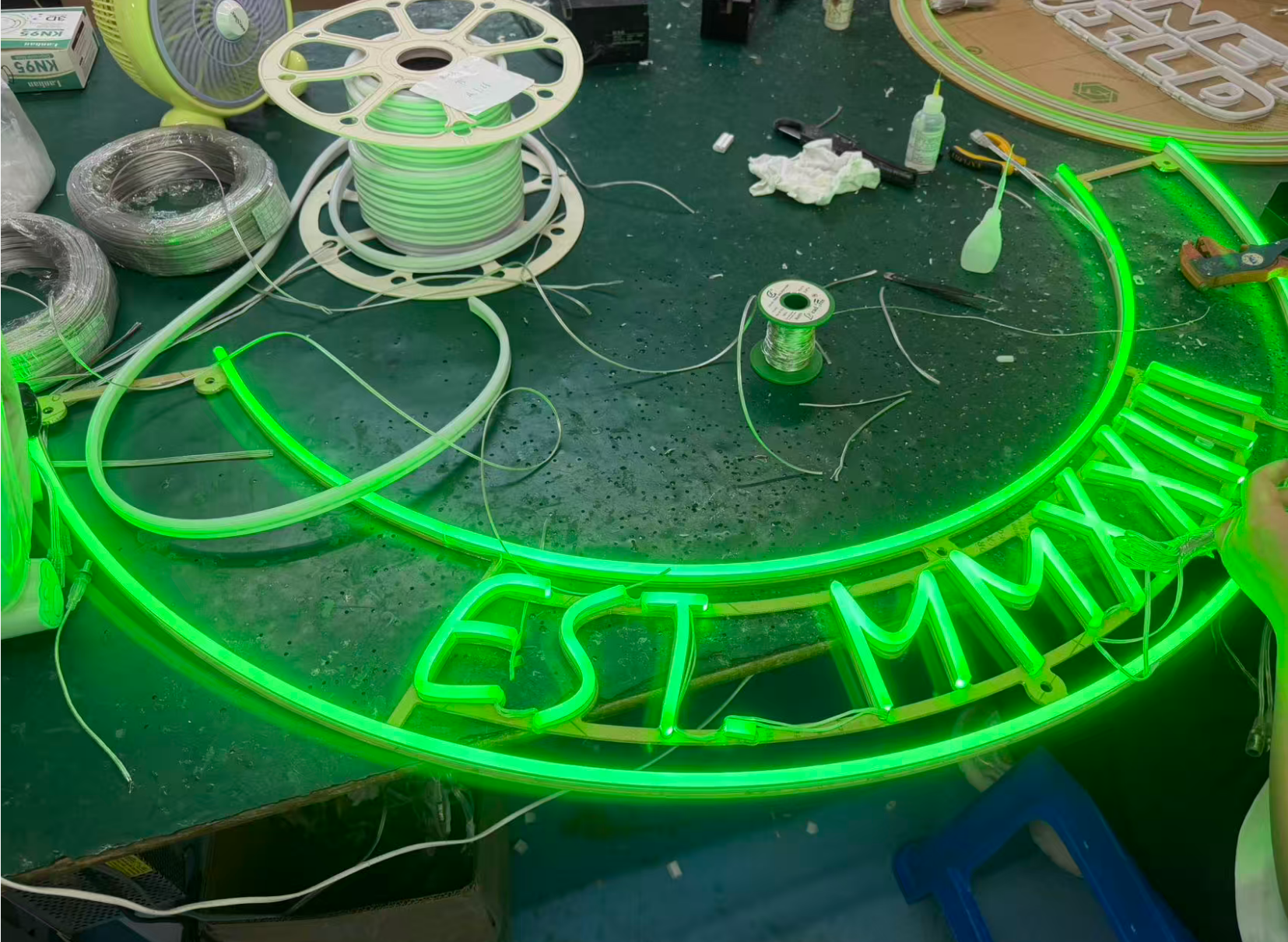
Every Custom Vasten Sign is placed on aging racks for continuous 24–48h full-brightness burn-in before packing.
During burn-in we monitor:
- Voltage/current stability across the low-voltage circuit
- Thermal behavior of silicone jacket, FPCB and driver load
- Brightness uniformity from first inch to last inch
- Color shift / dead LEDs / flicker / dim segments
- Driver stability under continuous load
The goal is simple: latent defects surface in Shenzhen, not at the client’s bar, retail store or event venue.
3) Multi-stage QC funnel
IQC — Incoming material control
- SMD bin check, CCT consistency, no random LED reels
- Silicone co-extruded jacket preferred; low-grade PVC sleeves rejected for UV/yellowing risk
- Cast acrylic or specified metal backboard inspected
- Drivers, plugs, dimmers and controllers checked for target-market compliance
IPQC — In-process build audit
- CNC/laser path vs approved vector
- Hand-bend radius, letter spacing, logo fidelity
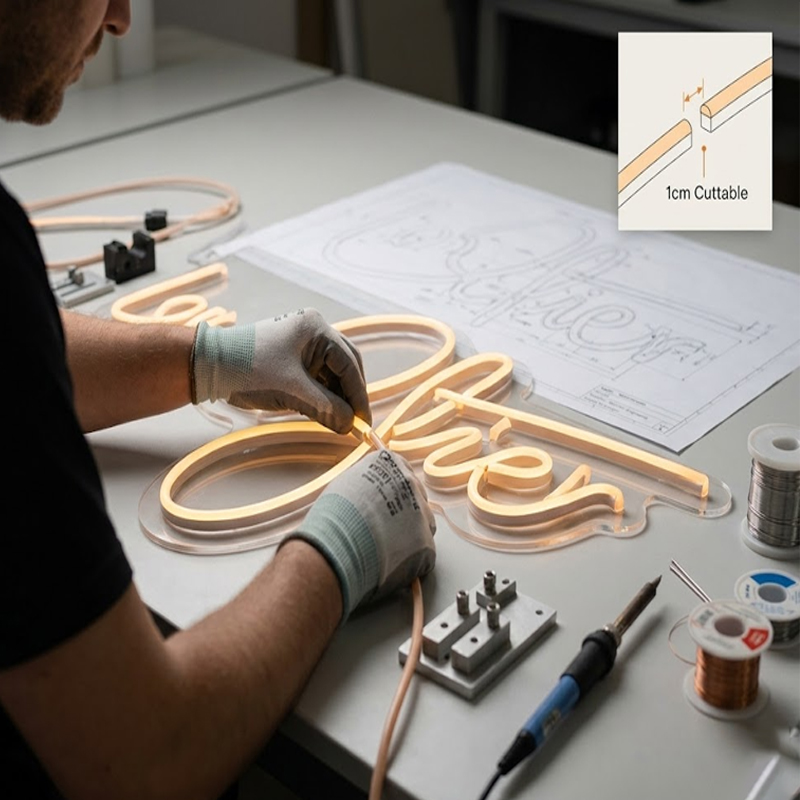
- Solder joint integrity, internal harness routing
- Correct 12V/24V layout, no loose connections before sealing
FQC — Final performance & safety
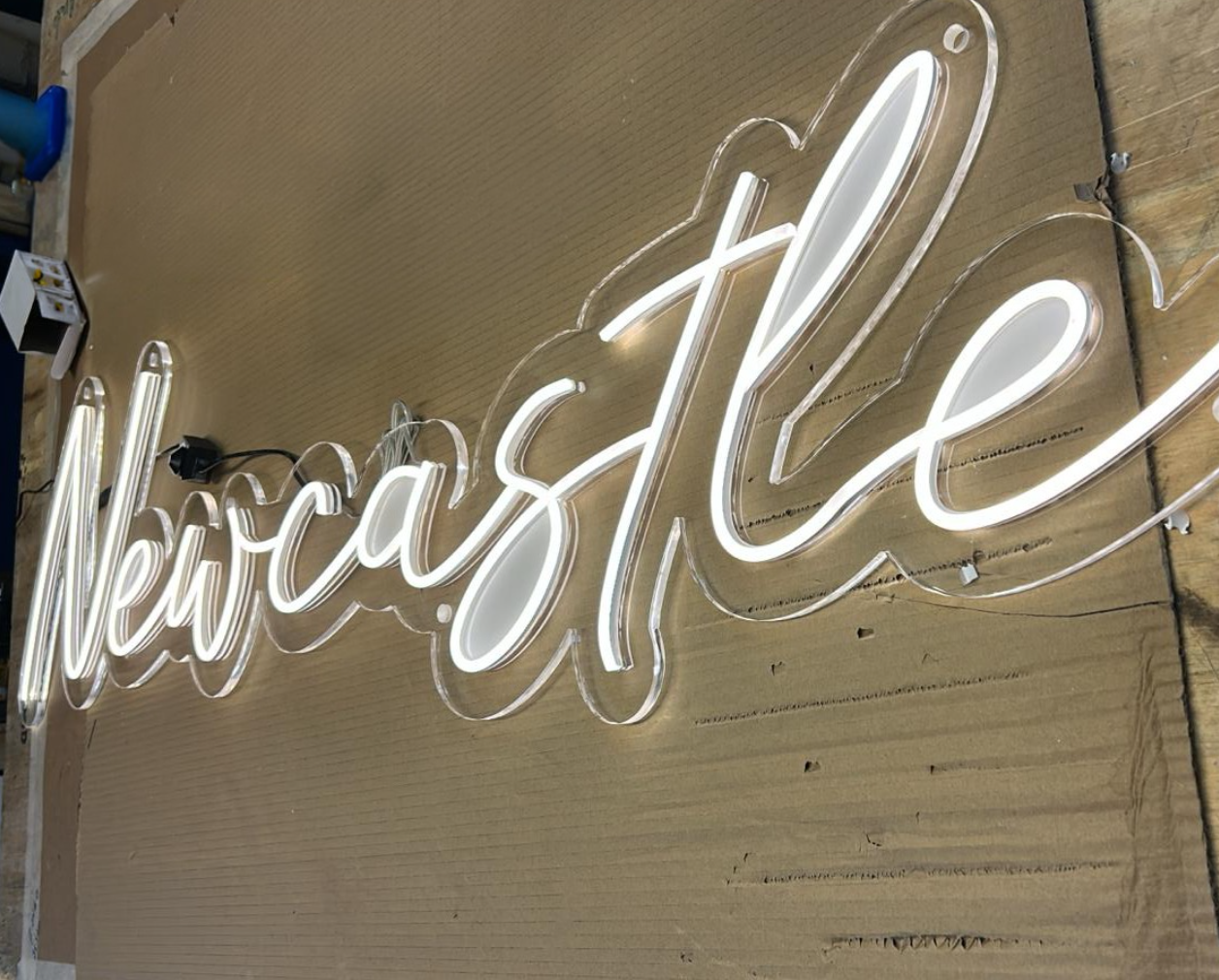
- Powered in dark room: no dark spots, no hotspots, no strobe
- Static/RGB/scene/DMX/APP control tested where applicable
- Insulation check, grounding continuity on metal-backplate builds
- IP spray/immersion validation for IP65/IP66/IP67 rated signs
- Photometric check available for CCT/CRI by specification
OQC — Outgoing audit & packing
- Compare physical sign to approved 3D mockup
- Confirm accessories: driver, dimmer, controller, plug, mount kit
- Cosmetic cleaning, export carton or wooden crate
- Pre-shipment photos/reports available for B2B and OEM accounts
4) Certification scope: CE/RoHS/FCC standard, UL by model
Vasten provides compliance documentation aligned to market requirements:
- CE / RoHS — standard scope on relevant custom signs and flex products
- FCC — EMI control for US-market resale and commercial use
- UL — available on selected models/projects; broader UL-certified models are being developed for retail and B2B programs
Buyers should note: UL is not automatically on every SKU. For US retail chains, municipal installs or insurance-reviewed venues, the safe process is to request UL scope per model before PO confirmation.
We also engineer signs to align with low-voltage luminaire safety principles — isolated driver, correct cable rating, strain relief and grounded metalwork where required.
5) Case examples from commercial projects
Commercial bar & lounge — cutout metal backplate, gradient RGB
Challenge: humid indoor environment, hidden wiring, metal grounding, even glow on reverse cutouts.
QC actions: silicone co-extruded flex, UV-stable clips, 12V harness grounded to plate, 48h burn-in, IP65 spray for spill-resistance.
Result: even gradient, no hot spots, no loose joints — photo-friendly signage that passes commercial electrical review.
Outdoor storefront & architectural outline
Challenge: rain, dust, temperature swing, long runs.
QC actions: silicone co-extrusion preferred; eco-PVC mini only for covered IP65 areas; all end caps/cable entries resealed with neutral-cure silicone; 24V long-run design to control voltage drop; burn-in + uniformity check.
Value: fewer water-ingress warranty claims vs unsealed PVC builds.
Wedding / event / entertainment installs
Challenge: guest safety, one-night perfection, reuse, international freight.
QC actions: silicone flex only, no glass gas tubes; 12V/24V driver with regional plug; dimming/scene test; 24–48h aging; dark-room uniformity.
Reference work includes Disneyland, Happy Valley and European royal-wedding project experience in Vasten’s Handmade Portfolio.
Global OEM / brand rollout
Challenge: brand-color consistency across markets, vector-accurate logos.
QC actions: SMD bin audit, 12V/24V layout review, CNC + hand-finishing, 24–48h burn-in, CE/RoHS/FCC; UL on selected models.
Value: consistent CCT across stores, fewer callbacks, export packing for global shipment.
6) Buyer checklist: how to vet a neon factory
When comparing suppliers, ask for written answers:
- Is burn-in 100% on custom signs? How many hours by product type?
- Is the architecture 12V/24V low-voltage with isolated driver?
- Is the jacket co-extruded silicone or sleeved PVC?
- What IP test method is used — spray, immersion, joint audit?
- Are solder joints, grounding and driver load tested?
- Which certs apply to the exact model: CE/RoHS/FCC/UL?
- Are pre-shipment photos and QC reports provided?
- How are end caps, cable glands and field cuts resealed?
Vasten answers these at quotation stage, not after production.
Conclusion
For commercial venues, the neon sign is a liability surface as much as a marketing asset. Vasten LED Neon answer is a low-voltage 12V/24V architecture, mandatory 24–48h burn-in, four-stage QC, IP65–IP67 ingress validation, and CE/RoHS/FCC compliance with UL on selected models/projects. That process is what allows the same factory line to serve a single wedding sign, a bar backwall, a façade outline and a global OEM rollout.
Send your vector/logo, size, indoor/outdoor IP grade, voltage/plug and control mode → we return a 3D mockup, compliance scope and factory quote.
Post time: Oct-16-2026


